Where I Usually Come In
Learning & Training
When people have been trained but still don't know what to do, I look at the gap between what was taught and what the job actually requires. Then I build training, tools, and follow-through around the way people really work.
Operations & Process Improvement
When work keeps getting dropped, duplicated, delayed, or handed to the wrong person, I find where the process is breaking and rebuild it with clearer ownership and handoffs.
Client & Partner Education
When the information is complicated but people still need to make decisions with it, I turn it into something they can understand, use, and act on.
Technology & AI Adoption
When a tool has potential but people aren't sure what to do with it, I help figure out where it actually belongs in the work, then build and teach a practical way to use it.
Selected Work
Case Study 01
Three Departments Were Talking to the Same New Hires. Nobody Had the Same Information.
Centria Autism
Sanitized professional case study
Recruiting, Onboarding, and Training were all communicating with new hires, but they weren't always working from the same information. Candidates could be told one thing by one department and something different by another. By the time the problem reached Training, we were spending time correcting information, tracking down missing requirements, and managing confusion that shouldn't have existed in the first place.
I traced the problem back to the handoffs. The departments didn't need another meeting. They needed a shared way to see what was happening, who owned what, and what candidates had already been told.
I built that system.
My role
I created the training section (an addendum) of the onboarding handbook, not the entire handbook, and I designed the process and tracking that coordinated Recruiting, Onboarding, and Training.
What I built
- A color-coded status tracker so every team could see each candidate's stage at a glance.
- A separate tracker that distinguished in-person and virtual participants in blended classes.
- Standardized communication templates and a consistent cadence, with Recruiting, Onboarding, and Training all copied so everyone worked from the same information.
- Training's policies and procedures shared with Onboarding and Recruiting, which closed the blind spot causing the misinformation.
- Clear ownership for each step of the handoff (below), and automation of the routine parts with company-approved technology and AI, kept as a living system that updates from feedback.
Green · Recruiting
Blue · Onboarding
Purple · Training
Red · Unassigned
How the handoff worked
- Recruiting or Onboarding communicated each candidate's missing requirements and deadlines.
- When a deadline passed without clearance, Training pulled the candidate from class and notified the candidate directly, copying Recruiting and Onboarding.
- The candidate was recorded as dropped, not failed.
- Training sent the internal list of who was pulled and why, then sent the final expected attendance count to the center, with Recruiting and Onboarding copied.
- Any remaining paperwork hold stayed with Recruiting or Onboarding. Training did not own a hold caused by another department.
Recruiting/Onboarding flag missing items + deadline→
Deadline passes, no clearance→
Training pulls candidate, notifies them (cc Recruiting & Onboarding)→
Recorded as dropped, not failed→
Pulled list + reasons sent→
Final attendance count to the center (cc both)→
Any paperwork hold stays with Recruiting/Onboarding
How it was implemented
I trained the trainers on the system and showed Onboarding and Recruiting why it mattered. It became how Training operated, and the other teams adopted it once they saw it working. I kept it a living process that updated from their feedback.
Result
The process contributed to a 20% reduction in onboarding time and reduced the administrative work trainers were doing to clean up problems created earlier in the process. More importantly, new hires got a clearer, more consistent experience from the beginning.
Training OperationsProcess ImprovementProcess StandardizationCross-Functional CollaborationStatus TrackingAutomationStakeholder AlignmentContinuous Improvement
Case Study 02
Training Didn't End When the Class Did
Centria Autism · American Red Cross Instruction
Sanitized professional case study
I learned early that completing training and being ready to do the job are not the same thing.
At Centria, I trained new hires virtually and in person, developed learning materials, coached other trainers, and taught employees how to use proprietary systems and complete required documentation. But some of the most important learning happened after class.
How I approach learning
My approach to learning and development is grounded in what happens after the training, not just what happens in the room. If someone completed the course but can't apply what they learned when the work is in front of them, I don't consider the learning complete.
I design learning to move across modalities based on the material, the environment, and what I'm seeing from the learner. Sometimes the answer is better facilitation. Sometimes it's demonstration, practice, a visual reference, a job aid, coaching, or reinforcement after training. I don't force every learner through the same experience simply because that's how the curriculum was originally built.
I use learner feedback, performance, and what happens in practice to determine what needs to change. The goal is learning that can transfer into the work, while the systems around it remain repeatable, adoptable, and scalable.
Training leadership
- Delivered multi-hour virtual and in-person training to non-clinical new hires
- Mentored newer trainers; evaluated instructor delivery and provided feedback and coaching
- Supported training scheduling and coordination; developed and adapted curricula
- Built instructional resources and job aids; evaluated training outcomes; provided post-training support
- Taught proprietary systems step-by-step and trained staff on documentation practices
- Helped employees integrate technology into their day-to-day workflows
I also served as a lead instructor and facilitator in American Red Cross First Aid/CPR training and certification, including observing and evaluating instruction and supporting other trainers. I am a certified First Aid/CPR instructor through 2028.
On-the-floor coaching, first 90 days
During a new hire's first 90 days, I observed them doing the actual work, identified where classroom understanding wasn't translating into practice, and coached them in real time without disrupting the child's care.
That gave me something a quiz couldn't: a clear view of whether the training actually worked.
Technical assistance
I provided the practical follow-through, walking employees through systems, documentation requirements, workflows, and performance expectations until they could actually apply what they learned in real work.
Adult LearningTraining FacilitationTrain-the-TrainerCoachingTechnical AssistanceCurriculum DevelopmentTraining EvaluationWorkforce DevelopmentSystems AdoptionDocumentation & ComplianceVirtual Facilitation
Case Study 03
Most People Don't Need More AI Information. They Need to Know What to Do With It.
Dafina Consulting · Independent
I kept seeing the same problem: people were being given prompts, tools, and terminology without enough understanding of how to think through what they were asking AI to do.
So instead of creating another list of prompts, I built a learning system around the part I thought was missing: context, structured thinking, and practice.
That became AI Made Simple, along with a book, workbook, Prompt Tree, AI Power Stack guide, assessments, visual resources, and custom GPTs people could actually interact with.
I designed the material for people with different levels of technical comfort and different ways of learning. The goal wasn't to make people sound knowledgeable about AI. It was to make them capable of using it.
Audience
Learners with different cognitive, technical, and learning needs, from nontechnical beginners to teams adopting new tools.
What I designed and built
- A workshop with live facilitation (the "AI Made Simple" workshop), plus presentations and visual learning assets
- Training materials, curriculum, and written resources, including a book, a workbook, the Prompt Tree, and the AI Power Stack guide (shown in Builds below)
- Interactive assessments that check for real understanding
- Custom GPTs built as hands-on learning tools
Tools
Instructional design, Canva, video editing, storyboards, Kahoot, Quizlet, and AI.
Evidence
The work itself, published and in use. Full versions of the book, workbook, and guides are protected; covers and samples are shown here.
Instructional DesignCurriculum DevelopmentAdult LearningWorkshop DevelopmentAssessment DesignFacilitationKnowledge TranslationDigital LearningTechnology Enablement
Case Study 04
The Work Wasn't Just Running the Operation. People's Lives Were Attached to the Details.
Choice Independence, LLC
No client-identifying information
For roughly a decade, I helped operate and grow a human-services organization serving people whose housing, healthcare, income, employment, and daily support could depend on getting the details right.
That meant operations couldn't be separated from people.
I recruited and managed staff, oversaw residential operations, held approximately $500,000 in budget and P&L responsibility, and helped double operational capacity. At the same time, I worked directly with individuals and families navigating SSI/SSDI, Medicaid and Medicare, supported employment, Social Security Work Incentives, documentation, and government agencies.
Sometimes the problem was operational. Sometimes it was a missing document. Sometimes it was helping a family understand a system they had never been taught how to navigate. My job was to figure out what stood between the person and the outcome they needed, then help move it forward.
Disability benefits & technical assistance
- Assisted individuals and families with SSI/SSDI applications, reviewing and completing documentation personally
- Communicated directly with Social Security Administration representatives on clients' behalf
- Helped clients understand documentation requirements and supported ongoing eligibility and benefit maintenance
- Helped clients navigate Social Security Work Incentives, and how hours, earnings, and resources could affect benefits and services
- Supported individuals in supported employment and vocational programs; assisted with income reporting
- Helped address overpayments and underpayments and maintain Medicaid and Medicare services
- Coordinated benefit requirements with available services and supports
Person-centered advocacy
I participated in person-centered planning meetings and worked across clients, families, social workers, state agencies, healthcare providers, vocational programs, service providers, and insurance and funding requirements. The work often meant translating what an individual or family actually needed into the documentation, planning, advocacy, and stakeholder communication required to obtain or keep appropriate services.
Operational leadership
- Recruited, interviewed, hired, trained, coached, and managed staff; defined staffing needs
- Managed residential and group-home operations and service resources
- Held approximately $500K in budget / P&L responsibility
- Maintained 100% client retention during my tenure and doubled operational capacity
SSI/SSDISocial Security Work IncentivesTechnical AssistancePerson-Centered PlanningSupported EmploymentVocational SupportsMedicaid/MedicareClient AdvocacyStakeholder EngagementHuman Services OperationsStaff Development
Case Study 05
I Built a Method That Helped Turn a Pilot Team Into the #1 Team on the Floor
Rocket Mortgage
Sanitized professional case study
Rocket Mortgage was piloting something new: working with clients from third-party banking partners.
I noticed that answering objections wasn't enough. People needed information presented in a way that matched how they made decisions.
I researched the financial environment and what delaying certain decisions could mean for clients. Then I developed a repeatable way to acknowledge an objection, respond with relevant information, and pivot the conversation based on what the person actually cared about.
I learned to listen for clues in the first few seconds of a conversation: Does this person want facts? Options? An expert they can trust? Do they need to understand what they could lose by waiting? I adapted the conversation accordingly.
The method worked well enough that I taught it to the rest of my team.
My role
Account Specialist on the pilot campaign.
What I did
- Ran independent research on what it could cost clients not to refinance or pull equity, given the economy at the time
- Built a repeatable way to acknowledge, respond, and pivot on objections using that research
- Learned to read a person's buyer type from the clues they give in the first several seconds, whether they want just the facts, a sense of what they would miss, an authority to trust, or a set of options, and adapted how I presented the information to fit
- Taught the full method to my sales team
Result
- Held the top one percentile for the full pilot campaign
- After my team adopted the method, we became the number one sales team on the floor
Also at Rocket Mortgage: partnered with an internal technology team to test new software from an operational-user perspective, surface issues, and recommend workflow improvements; later, in Capital Markets, managed a book of third-party banking relationships and educated partners on products, pricing, and rate changes.
Evidence
No work sample. The materials became company property and are no longer accessible, so this is presented as a documented account of the work and its results.
Knowledge TransferPeer TrainingAdaptive CommunicationFinancial LiteracyConsultative CommunicationObjection HandlingNeeds AnalysisPerformance ImprovementPartner Enablement
Case Study 06
Before You Design the Service, You Need the Right Questions
SUN Catering
No client-identifying information
A catering client can tell you what food they like and still not tell you enough to design the experience they actually want.
I created a discovery process that went beyond menu choices. It asked about priorities, budget, presentation, dietary needs, what guests should remember, and where the client was willing to compromise.
Then I translated those answers into a clearer service structure: what was included, how changes would be handled, when payments were due, and what each side could expect.
The point wasn't to create more paperwork. It was to reduce ambiguity before ambiguity became a problem.
The discovery questionnaire I designed
A short, friendly intake that draws out the real brief instead of a vague "make it nice":
- Menu preferences, from starters through dessert
- The feeling they want guests to leave with, and the moments they most want remembered
- How much taste matters versus presentation
- Budget range and ranked priorities (ingredients, presentation, variety, service, specialty dishes)
- Theme or inspiration, the final taste to end on, and any dietary needs
The service-agreement structure I outlined
- What's included: menu planning, preparation, delivery, setup and teardown, serving staff, and cleanup
- How changes are handled: in writing, as an addendum, agreed before the event
- Payment milestones: a deposit to hold the date, the per-person balance before the event, and the remaining fee the day before
Shown as a general, anonymized example of how I structure discovery and service terms. It is not legal advice and was not reviewed by an attorney, and it contains no client information. Presented as service-design work, not a completed event.
Client DiscoveryRequirements GatheringIntake DesignService DesignProcess DesignStakeholder CommunicationOperations
Case Study 07
How Do You Create Revenue Without Putting the Existing Community Behind a Paywall?
The Creative Space
Proposal & planning · not launched
The Creative Space already had free community gatherings. The opportunity I saw wasn't to start charging people for what they already had. It was to build something additional that could generate recurring revenue while protecting the accessibility of the existing community.
I developed The Forge, a proposed paid membership model with its own value proposition, benefits, operating structure, and revenue scenarios.
What I designed
- A one-page pitch and a full plan: the vision, the membership structure and benefits, and how it would run alongside the existing free community
- A revenue model with membership scenarios
- The positioning and rationale for why the model fits the organization's mission
Status
The concept has not been launched, so I don't present hypothetical results. It's included here because it shows how I approach a business-model question: protect what already works, identify what can create additional value, and design the operation around both.
Program DesignProposal DevelopmentCommunity DevelopmentBusiness ModelingStrategy
Builds
Things I've Built to Solve Things I Actually Care About
I build when I keep running into a problem and can't find quite what I'm looking for.
Some of those solutions are training materials. Some are frameworks, guides, workshops, or custom GPTs. I use tools like ChatGPT, Claude, Canva, and other technology to prototype, test, and improve them.
The technology isn't the point. What the person can do better because of it is.
Custom GPTs & tools

Ops Level Up
Career-strategy GPT: visibility, positioning, income

Emperor Era Coach
Check-in coach for ADHD & neurodivergent productivity

BPE
Brand voice & content generation
Emperor Era Coach, for example, factors in a user's mood and focus, challenges procrastination, and is refined through scenario testing of its tone and objectives. It is a productivity companion, not a clinical tool.
Curriculum & training materials
Custom GPTsPrompt DesignGPT Development & TestingInstructional ProductsGenerative AITechnology Adoption
Recognition
My custom GPT earned Second Place in Think Technologies' inaugural "Prompt It" Creator Competition in 2026, recognized for creativity, original thinking, and use of AI.
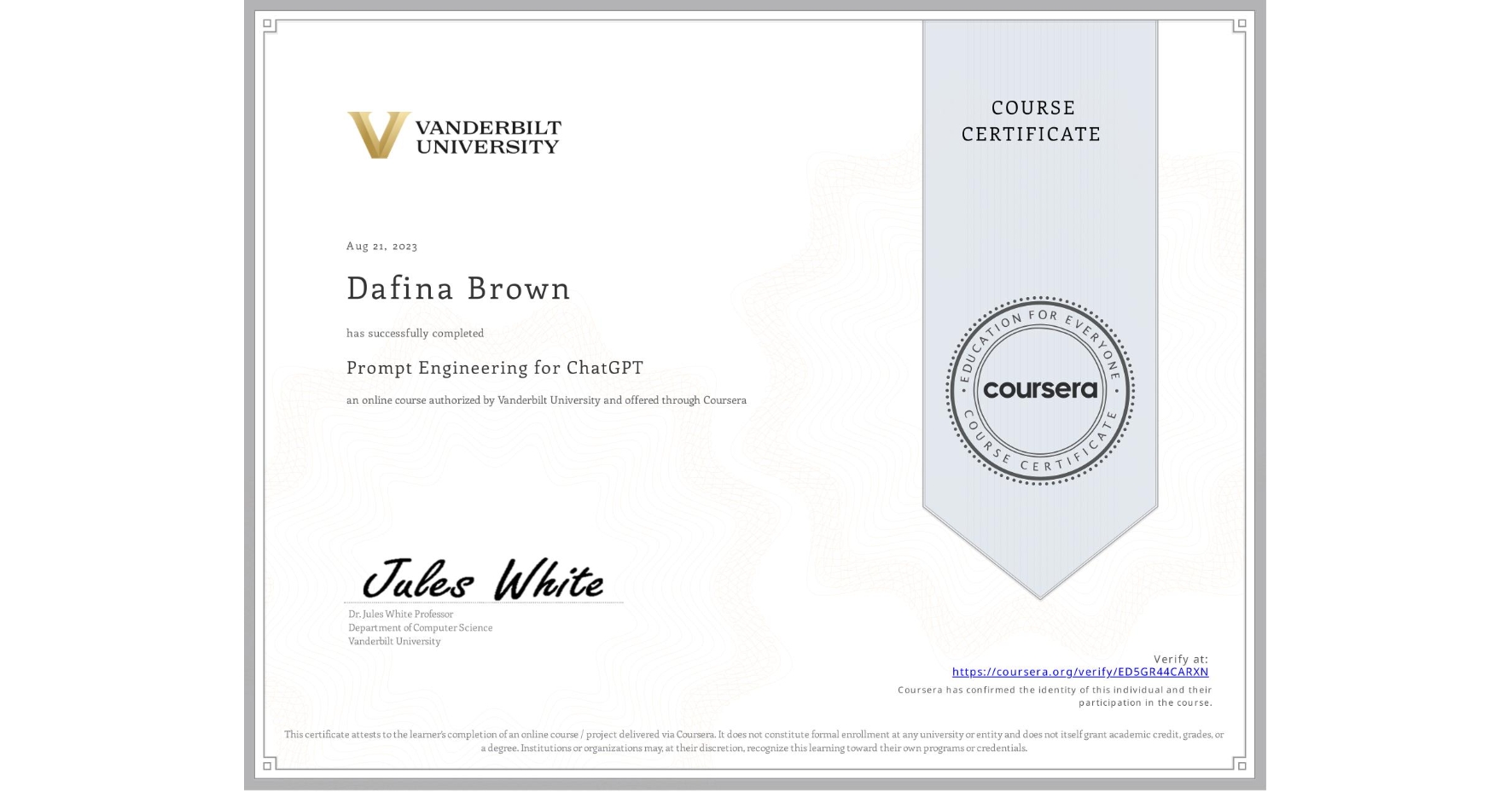
My formal work with generative AI began in 2023, when I completed Vanderbilt University's Prompt Engineering for ChatGPT program. Since then, I've continued building, testing, teaching, and finding practical applications for the technology.
I also developed Keep That Same Energy, a networking practice game submitted to the Black Tech Saturdays Creative Control competition after noticing a problem with how connections made in the room carried, or didn't carry, beyond it.
2nd Place · Prompt It (2026)Vanderbilt · Prompt EngineeringCritical Thinking
How I Work
How I Think About the Work
I don't come in assuming everything needs to be rebuilt. Usually, it doesn't.
I start with the intended outcome, then look at the data, the user experience, and the people and teams closest to the work. I want to understand what's already working, what isn't, what's been missed or mishandled, and where the real friction is before I change anything.
From there, I look for the simplest solution that can produce the right result. Sometimes that's a new system. Sometimes it's fixing a handoff, changing how information is communicated, adapting the training, clarifying ownership, or making better use of something that's already there.
I keep the return on the effort in mind. A solution isn't better because it's bigger, newer, or more complicated. It has to justify the time, cost, and disruption required to implement it.
Whatever the solution, I want it to be repeatable, adoptable, and scalable, grounded in data and the experience of the people who actually have to use it.
Keep what works. Find what's getting in the way. Fix what matters. Build only what the outcome requires.
Diagnose→
Translate→
Design→
Implement→
Teach→
Improve
Diagnose
Figure out what's actually wrong before building something to fix it.
Translate
Make the complicated understandable without stripping away what matters.
Design
Build what the problem actually calls for, whether that's a process, training, tool, resource, or something else.
Implement
Get it out of the document and into the work.
Teach
Make sure the people using it understand not only what to do, but how to do it confidently.
Improve
Watch what happens once real people get their hands on it. Keep what works. Change what doesn't.
Capabilities & Credentials
Training & Learning
- Training & Facilitation
- Adult Learning
- Instructional Design
- Curriculum Development
- Train-the-Trainer
- Training Evaluation
- Technical Assistance
- Technology Enablement
Operations & Improvement
- Process Improvement
- Continuous Quality Improvement
- Person-Centered Planning
- SSI/SSDI & Work Incentives
- Stakeholder Engagement
- Workforce Development
Technology & Tools
- Zoom · Microsoft Teams · Slack
- Microsoft 365 · SharePoint
- Google Workspace
- Canva · Adobe
- DocuSign
- Salesforce · CareConnect
- Power BI & Reporting
- Custom GPTs · Generative AI
Certifications
- Vanderbilt — Prompt Engineering
- Vanderbilt — AI for Project Management
- Google — AI Essentials · Introduction to AI
- Anthropic — AI Fluency · Claude 101
- American Red Cross — First Aid/CPR Instructor (through 2028)